
Kitchen & Food Preparation Area Cleaning
Specialist childcare kitchen cleaning across Melbourne. AS/NZS 4146 compliant food-safe and GECA-certified child-safe products — benchtops, appliances, sinks, utensils, and crockery cleaned after every food service session. NQS Quality Area 2 compliance documentation included. Signed logs every visit.
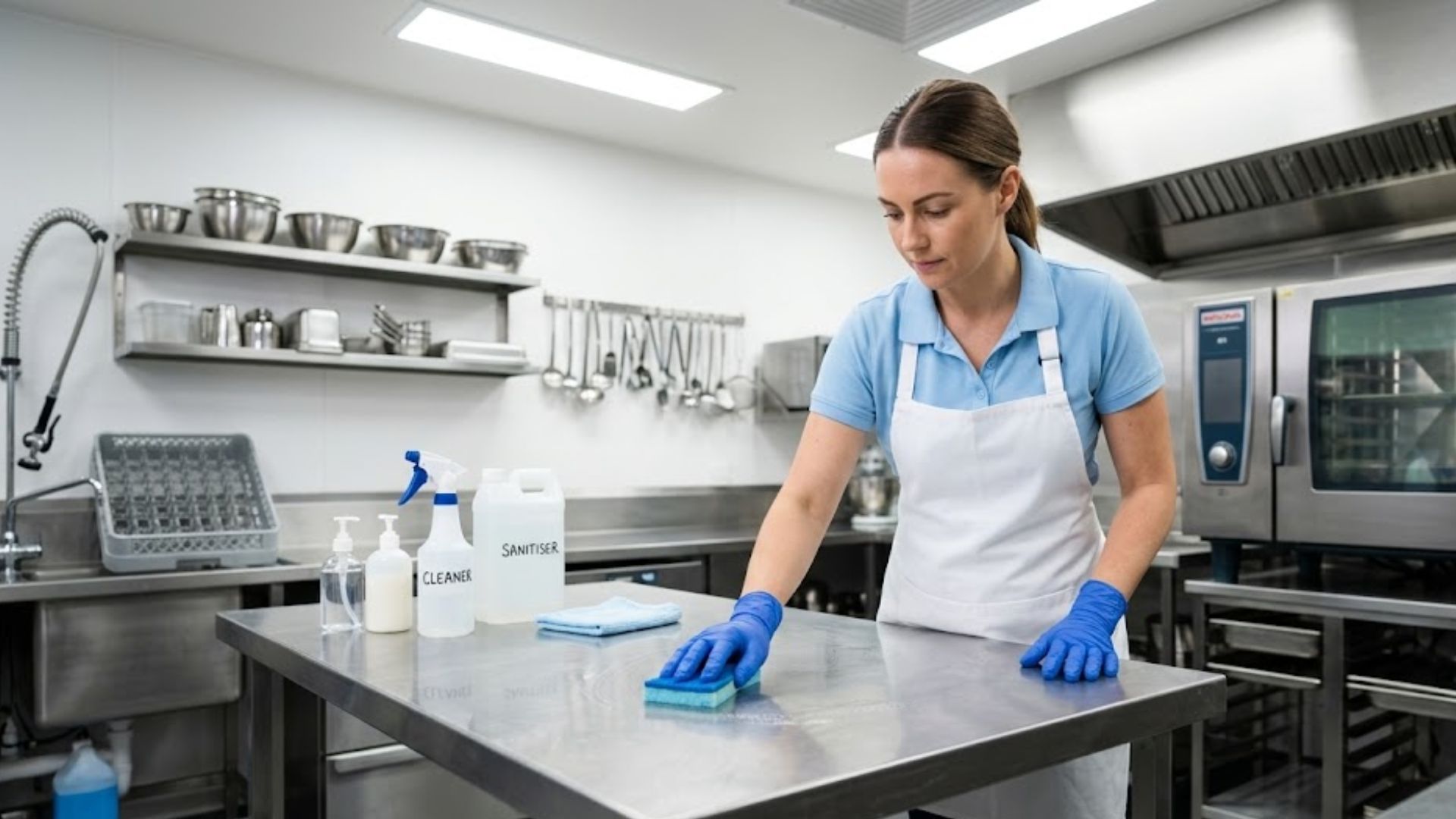
Childcare Kitchen Cleaning Must Meet Two Standards Simultaneously
Childcare kitchens and food preparation areas present a unique cleaning challenge that does not exist in any other facility type: every product used must simultaneously be food-safe and child-safe. A product that kills foodborne pathogens but leaves a toxic residue on food contact surfaces fails the child-safety test. A GECA-certified general cleaner that is safe around children but lacks proven food-contact sanitisation efficacy fails the food-safety test. Golden Star uses products that satisfy both requirements — for every surface in every childcare kitchen we clean across Melbourne.
Food Safety Standard — AS/NZS 4146
AS/NZS 4146 is the Australian and New Zealand standard governing the sanitisation of food contact surfaces. Products used on childcare kitchen benchtops, sinks, appliances, and utensils must comply with this standard — meaning they are effective against foodborne pathogens including Salmonella, E. coli, Listeria, and Campylobacter at the concentrations stated on the label, and do not leave harmful residue on surfaces where food is prepared or placed.
Child Safety Standard — GECA Certified
GECA (Good Environmental Choice Australia) certification is the NQS Quality Area 2 product standard for all areas where children are present. Products used in childcare kitchens must be GECA-certified to confirm they contain no harmful chemicals, are non-toxic, and are safe in environments where children aged 0–6 will be immediately adjacent to cleaned surfaces. GECA certification is accepted by ACECQA assessors as evidence of appropriate product selection under NQS Quality Area 2.
What's Included in Our Childcare Kitchen Cleaning Service
Golden Star's childcare kitchen cleaning service covers every surface zone in the food preparation area after each food service session. All products meet AS/NZS 4146 for food contact surfaces and GECA certification for child-safe environments. Every clean is documented in a signed compliance log for NQS Quality Area 2 assessment evidence.
Benchtops & Food Preparation Surfaces
Two-step clean-then-sanitise process on all benchtop and food preparation surfaces after every session. Food-safe detergent removes soil and grease; AS/NZS 4146-compliant sanitiser applied at full contact time. No petrochemical products on food contact surfaces under any circumstances.
Sinks, Taps & Drain Areas
Kitchen sinks, tap handles, and surrounding bench surfaces cleaned and sanitised after every food service session. Drain opening cleared of food debris. Sink drainer rack cleaned. Cross-contamination risk between food prep and handwashing functions addressed with separate cleaning cloths.
Appliance Exteriors — After Every Session
Exterior surfaces of all kitchen appliances — microwave, oven, refrigerator, dishwasher, kettle, toaster — wiped down after every food service session. Appliance handles and controls, which are high-touch surfaces, disinfected after every use. Appliance interiors addressed during weekly deep cleaning schedule.
Utensils & Crockery Protocol
All utensils and crockery used in food service washed in a dishwasher at a minimum rinse temperature of 82°C for thermal sanitisation. Where handwashing is required, food-safe detergent used with hot water followed by air-dry. Cracked or chipped items removed and reported — surface damage creates bacterial harbourage sites that cannot be adequately sanitised.
High Chair Trays & Feeding Surfaces
High chair trays and all surfaces used directly for child feeding cleaned and sanitised after every meal service. AS/NZS 4146 compliant sanitiser applied at the correct concentration. Particular attention to tray edges and tray mounting points where food accumulates. Trays air-dried before next use.
Waste Bins & Floor Areas
Food waste bins emptied and relined after every food service session. Bin surrounds and floor areas swept and mopped using food-safe, child-safe floor cleaner. Waste bin exteriors wiped down. Floor drains cleared of food debris after each session.
Signed Compliance Log — Every Visit
Signed, itemised compliance log after every kitchen clean — recording areas cleaned, products used (with AS/NZS 4146 and GECA certification references), time, and staff details. Formatted for NQS Quality Area 2 ACECQA assessment evidence. Retained 12+ months.
Response within 1 business day · Free assessment · No obligation
The Correct Food Prep Area Cleaning Procedure in Childcare
The correct cleaning procedure for food preparation surfaces in childcare follows a mandatory two-step process defined in NHMRC Childcare Cleaning Guidelines and AS/NZS 4146. Applying sanitiser to a dirty surface does not achieve sanitisation — organic matter (food residue, grease, protein) physically blocks the sanitiser from reaching and killing pathogens. The clean-then-sanitise sequence is not optional.
Clean First — Remove All Soil
Apply food-safe detergent to all food preparation surfaces. Scrub to remove all visible food residue, grease, and protein deposit. Rinse with clean water. This step removes the organic matter that would otherwise block the sanitiser in step two from reaching the surface. A surface that looks clean but has not been actively scrubbed with detergent is not adequately prepared for sanitisation. All cleaning cloths used in this step are disposed of or laundered after each use — not reused across sessions.
Sanitise Second — Kill Pathogens
Apply AS/NZS 4146-compliant sanitiser to the cleaned, rinsed surface. Maintain the full contact time specified on the product label — this is the minimum time required for the sanitiser to achieve the pathogen kill efficacy stated in its TGA or AS/NZS 4146 registration. Do not wipe the surface immediately after application. After contact time, wipe down or allow to air-dry as specified for the product. The surface is now both clean and sanitised. Every Golden Star kitchen clean follows this two-step sequence without exception.
Kitchen Cleaning Frequency Requirements
Childcare kitchen cleaning has three frequency tiers. The daily after-session clean must address every food contact surface and waste area. Weekly deep cleaning covers appliance interiors and hard-to-reach areas. Term break deep cleans address behind-unit areas, deep grease removal, and full appliance inspection.
Daily Kitchen Clean
- Two-step clean & sanitise all benchtops
- Clean and sanitise sink and taps
- Wipe all appliance exteriors and handles
- Sanitise high chair trays after every meal
- Wash and sanitise all utensils and crockery
- Empty food waste bins, reline, clean surrounds
- Sweep and mop floor — food-safe product
- Sign and file compliance log
Weekly Deep Kitchen Clean
- Clean interior of microwave and oven
- Clean inside refrigerator and freezer
- Descale kettle and coffee machine
- Clean dishwasher filter and door seals
- Degrease rangehood and filters
- Clean splashback tiles and grout
- Clear and clean floor drains
- Inspect and report any damaged utensils
Term Break Deep Clean
- Pull out and clean behind all appliances
- Full oven deep clean — racks and cavity
- Replace rangehood filters if required
- Deep clean all cupboard interiors
- Check plumbing under sink
- Inspect all utensils — dispose if cracked
- Full product register review
- ACECQA documentation provided
Food-Safe & Child-Safe Products for Childcare Kitchens
Every product used by Golden Star in childcare kitchen cleaning meets two independent certification standards simultaneously. AS/NZS 4146 compliance is required for all food contact surfaces — it ensures products are effective against foodborne pathogens at the concentrations used and do not leave residue that contaminates food or food contact surfaces. GECA certification is required for all areas where children are present — it ensures products are non-toxic, environmentally responsible, and safe in environments occupied by children aged 0–6.
No petrochemical cleaners, bleach-based products, or ammonia compounds are used on any kitchen surface in any Golden Star client facility. A full product register is available on request and is formatted for inclusion in your centre's ACECQA assessment documentation file and your food safety management plan.
How Utensils and Crockery Should Be Cleaned in Childcare
Utensils and crockery used in childcare food service must be sanitised to a standard that cannot be reliably achieved by handwashing alone. The most effective and recommended method is mechanical washing in a dishwasher with a final rinse temperature of 82°C minimum — this provides thermal sanitisation without chemical residue and meets AS/NZS 4146 requirements for food contact surface sanitisation.
Where handwashing is necessary — for items too large for the dishwasher, or in facilities without a dishwasher — food-safe detergent and hot water must be used, followed by a complete air-dry. Drying with a cloth re-contaminates items and should never be used as standard practice in a regulated childcare facility.
Any utensil or crockery item that is cracked, chipped, or surface-damaged must be removed from service immediately. Surface damage creates micro-harbourage sites where bacteria accumulate and survive even after washing. Golden Star's kitchen cleaning protocol includes a utensil condition inspection during every weekly deep clean and term break service.
NQS Quality Area 2 — Kitchen & Food Prep Compliance
NQS Quality Area 2 — Children's Health and Safety — applies to all areas of a childcare facility including kitchens and food preparation areas. Under Quality Area 2, ACECQA assessors examine the centre's food safety and kitchen hygiene practices, including the products used, the cleaning procedures followed, and the documentation maintained. A centre using general commercial cleaning products in its kitchen — products that are neither AS/NZS 4146 compliant nor GECA-certified — may be found to have inadequate kitchen hygiene practices under Quality Area 2.
NHMRC Childcare Cleaning Guidelines provide specific protocols for kitchen and food preparation areas that align with both NQS Quality Area 2 and AS/NZS 4146. These include the mandatory clean-then-sanitise two-step sequence, minimum sanitiser contact times, and the requirement for separate cloths and equipment for food contact surfaces versus general cleaning areas.
Golden Star's childcare kitchen cleaning service produces signed compliance logs after every clean, uses products meeting both AS/NZS 4146 and GECA certification requirements, and is performed by staff holding current Victorian Working With Children Checks under the Working with Children Act 2005 (Vic). View all childcare cleaning services or pricing.
Daily Kitchen Compliance Checklist
- Benchtops — clean & sanitise (two-step)
- AS/NZS 4146 product — full contact time observed
- Sink and taps cleaned and sanitised
- All appliance exteriors wiped
- High chair trays sanitised after each meal
- Utensils and crockery — 82°C dishwash or handwash with air-dry
- Waste bins emptied and relined
- Floor swept and mopped — food-safe product
- Separate cloths used — no cross-contamination
- Signed compliance log completed
- Records retained 12+ months on file
Childcare Kitchen Cleaning — Frequently Asked Questions
Common questions about childcare kitchen and food preparation area cleaning. For a full list, visit our childcare cleaning FAQ page.
Get a Free Childcare Kitchen Cleaning Quote in Melbourne
Call or submit online to arrange a free on-site assessment and written kitchen cleaning programme for your Melbourne childcare centre. All services include AS/NZS 4146 compliant and GECA-certified products, NQS Quality Area 2 compliance documentation, and WWCC-verified staff. 25 suburbs, no travel surcharge. No lock-in contracts. View all childcare cleaning services.