
Toy Sanitisation & Equipment Cleaning
Professional toy sanitisation for Melbourne childcare and daycare centres. Separate protocols for plastic, soft, wooden, and sensory toys — matched to NHMRC Childcare Cleaning Guidelines and age-group mouthing risk. GECA-certified enzyme-based sanitisers. Signed compliance records after every service.
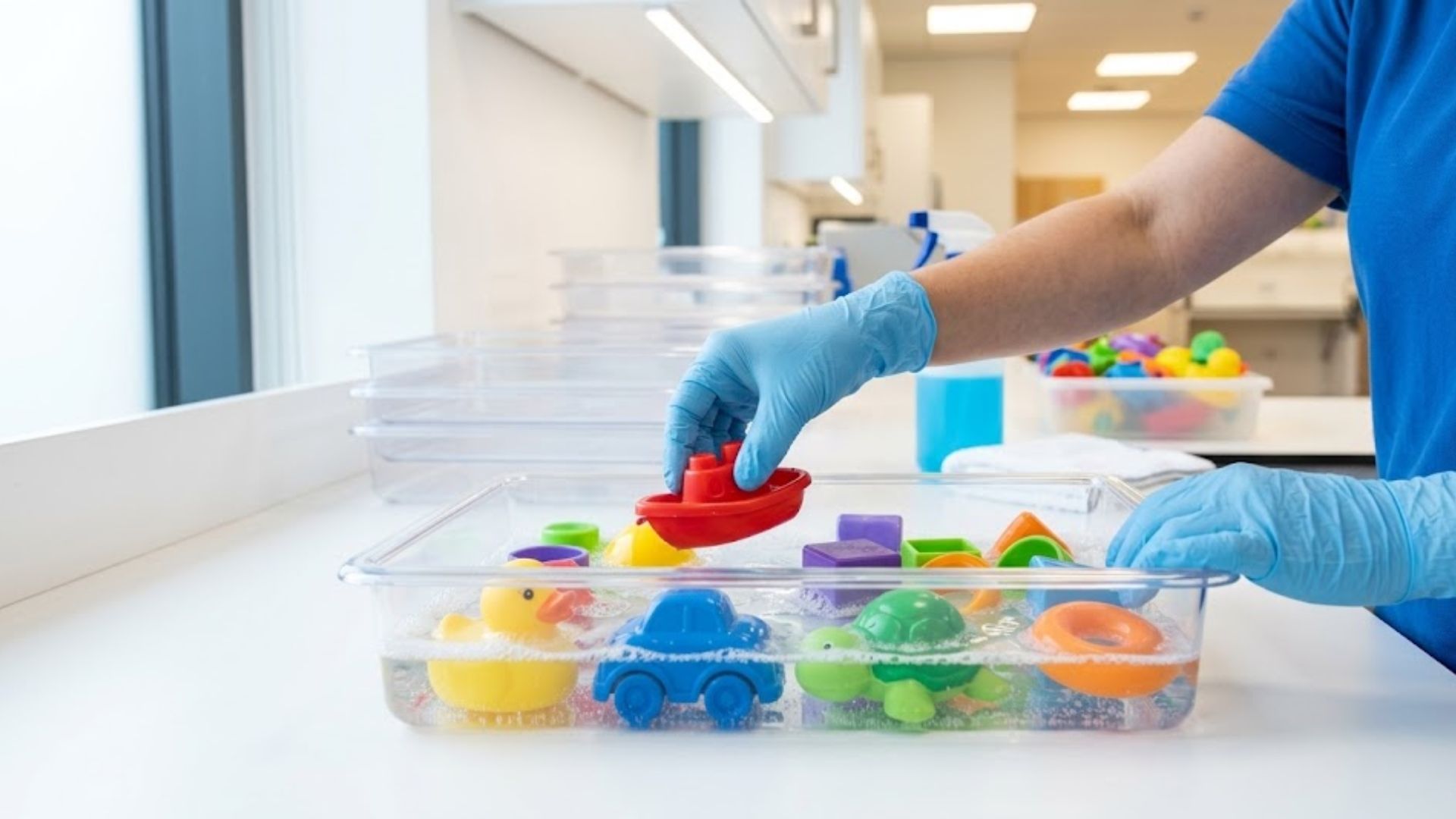
Why Toy Sanitisation Is a Primary Infection Control Measure
Shared toys are one of the primary transmission routes for respiratory and gastrointestinal illness in childcare settings. Children aged 0–5 frequently mouth toys — placing plastic blocks, wooden animals, rubber figures, and sensory materials directly in their mouths. This transfers oral secretions carrying rhinovirus, influenza A, RSV (respiratory syncytial virus), norovirus, and rotavirus directly from one child's mouth to the hands and mouth of the next child who uses that toy.
NHMRC Childcare Cleaning Guidelines identify toy sanitisation as a key infection control measure in all early childhood education settings. Without a systematic, material-specific toy sanitisation programme, a childcare or daycare centre's infection control framework has a significant gap that contributes directly to the illness rates that affect enrolment, staffing, and family confidence. Regular toy sanitisation does not merely reduce illness events — it is a documented NQS Quality Area 2 compliance obligation.
Primary Mouthing Risk
Children under 5 mouth toys as a developmental behaviour. A single mouthed toy that is not sanitised before the next session can transmit rhinovirus, RSV, norovirus, and rotavirus directly to every child who touches or mouths that toy.
Pathogen Survival on Toys
Norovirus survives on hard plastic surfaces for days without disinfection. Rhinovirus survives up to 24 hours. RSV survives 6 hours on hard surfaces. Sanitisation breaks the chain — an unsanitised toy collection creates a persistent illness reservoir in the play environment.
NQS Compliance Requirement
NQS Quality Area 2 requires documented infection control practices. Toy sanitisation records are one of the specific pieces of documentation ACECQA assessors may request during a quality assessment. Golden Star provides these records as standard after every toy sanitisation service.
Toy Cleaning Procedures by Material Type
The correct toy cleaning procedure in childcare depends entirely on the material. A protocol suitable for hard plastic — full immersion in sanitiser solution — will warp and crack wooden toys. A protocol suitable for soft toys — hot machine wash — will damage sensory bin materials. Golden Star applies separate, material-specific cleaning procedures to every toy type, matching both the cleaning method and the product to what is safe and effective for that material.
Hard Plastic Toys
- 1Pre-wash with warm water and GECA-certified detergent to remove visible soil and saliva residue
- 2Apply GECA-certified enzyme-based sanitiser — spray or immersion as appropriate to toy size
- 3Maintain contact time as specified on product label — typically 3–5 minutes for full pathogen kill
- 4Rinse thoroughly with clean water — remove all sanitiser residue
- 5Air-dry completely before return to play area — minimum 2 hours
- 6Inspect for cracks or damage — remove and dispose of any cracked items
Soft Toys & Fabric Items
- 1Check care label — confirm machine-washable at 60°C minimum
- 2Machine wash on hot cycle at minimum 60°C using fragrance-free, child-safe laundry detergent
- 3Tumble-dry fully on high heat — no residual moisture in any seam or fill
- 4Allow to cool completely before return to under-2 or toddler rooms
- 5Inspect seams, eyes, and attachments post-wash — remove and dispose if damaged
Wooden Toys
- 1Wipe surface with a damp cloth only — do not submerge in water, which causes warping and mould growth
- 2Apply GECA-certified enzyme-based cleaner to the damp cloth and wipe all surfaces
- 3Wipe down with a clean damp cloth to remove any residue
- 4Sun-dry or air-dry in a well-ventilated area for minimum four hours before return to play area
- 5Inspect for splinters, cracks, or paint lifting — remove and dispose of any damaged items
Sensory Bins & Water Play
- 1Empty all sensory materials — dispose of sand, rice, pasta, or other fill (do not reuse after illness events)
- 2Scrub bin interior with GECA-certified detergent and warm water
- 3Rinse thoroughly — remove all detergent residue from all internal surfaces
- 4Air-dry upturned in a clean, ventilated area — minimum four hours
- 5Refill with fresh materials before next session — never reuse bin materials
What's Included in Our Toy Sanitisation Service
Golden Star's toy sanitisation service covers every toy type in your centre using the correct material-specific protocol for each. Every service produces signed compliance documentation for NQS Quality Area 2 assessment and can be scheduled as a standalone service or as part of an existing routine cleaning agreement.
Hard Plastic Toy Sanitisation
Pre-wash, GECA-certified enzyme sanitiser application with full contact time, thorough rinse, and complete air-dry for all plastic toys. Cracked or damaged items removed and reported for disposal.
Soft Toy Laundering
Machine wash at minimum 60°C with fragrance-free, child-safe detergent, full tumble-dry, and inspection before return. Soft toys confirmed fully cooled and dry before placement in any infant or toddler room.
Wooden Toy Cleaning
Enzyme-based damp wipe protocol — no submersion — followed by minimum four-hour sun or ventilated air-dry. Inspection for splinters, cracks, and paint lifting. Damaged items removed and reported.
Sensory Bin Cleaning & Refill
Complete empty and dispose of bin materials, interior scrub and rinse, full air-dry, and refill with fresh materials. Water play equipment emptied, cleaned, and dried between uses.
Under-2 Room Priority Sanitisation
Under-2 and toddler rooms receive priority scheduling and enhanced frequency. All frequently mouthed toys in infant and toddler rooms sanitised daily as standard. Daily sanitisation records maintained separately for under-2 rooms.
Signed Compliance Records
Signed, itemised toy sanitisation records after every service — recording toy types treated, products used, protocols applied, and date. Ready-made NQS Quality Area 2 evidence for ACECQA assessment, retained 12+ months.
Response within 1 business day · Free assessment · No obligation
Toy Sanitisation Frequency by Age Group
NHMRC Childcare Cleaning Guidelines specify toy sanitisation frequency based on the age group using the toys and the level of mouthing behaviour. Frequency requirements are highest for under-2 rooms and decrease with age as mouthing behaviour reduces and children develop more consistent hand hygiene.
Under-2 Rooms
- Frequently mouthed toys sanitised daily
- Shared plastic toys sanitised after every session
- Soft toys laundered minimum twice weekly
- Sensory bin materials replaced weekly minimum
- All toys sanitised immediately after any illness event
- Daily sanitisation records maintained separately
Toddler Rooms
- Shared plastic toys sanitised weekly minimum
- Frequently mouthed items sanitised daily
- Soft toys laundered weekly
- Wooden toys wiped and dried weekly
- Sensory bins cleaned and refilled weekly
- All toys sanitised immediately after illness event
Pre-School Rooms
- Shared plastic toys sanitised weekly
- Soft toys laundered weekly
- Wooden toys wiped and dried weekly
- Sensory bins cleaned and refilled weekly
- Art materials cleaned after each use
- All toys sanitised immediately after illness event
GECA-Certified Enzyme Sanitisers for Toy Cleaning
Toy sanitisation products must satisfy two competing requirements simultaneously: they must be effective enough to kill the pathogens responsible for illness transmission in childcare settings — rhinovirus, RSV, norovirus, rotavirus — and they must be completely safe when residue is later mouthed by children. Standard commercial disinfectants, including bleach-based products, meet the first requirement but not the second. Bleach residue on toys is a chemical hazard for children who mouth them.
Golden Star uses GECA-certified, enzyme-based sanitisers for all toy cleaning. Enzyme-based products break down biological matter — including viral particles and bacterial biofilm — through a biochemical process rather than harsh chemical action. They are non-toxic after drying, safe for child contact, and effective against the pathogens of concern in childcare settings. All products are VOC-free and fragrance-free where possible. A full product register is available on request for ACECQA assessment documentation.
Why Bleach Is Unsuitable for Childcare Toy Cleaning
Bleach-based disinfectants are commonly used in commercial cleaning environments — but they are unsuitable for toys that children mouth for several reasons. Sodium hypochlorite (household bleach) leaves a chemical residue on surfaces that is not removed by rinsing alone and is harmful when ingested by children in the concentrations typical of cleaning applications.
Bleach also degrades plastic over time — causing cracking and surface pitting that creates harbourage sites for pathogens, increases the risk of injury from sharp plastic edges, and makes toys harder to clean effectively in subsequent services.
GECA certification explicitly excludes products with harmful residue profiles. Any toy cleaning product that leaves a harmful residue on child-contact surfaces cannot carry GECA certification — which means any provider using bleach on childcare toys is using products that fall outside the NQS Quality Area 2 product standard.
NQS Quality Area 2 — Toy Sanitisation Compliance
NQS Quality Area 2 — Children's Health and Safety — requires that approved childcare providers maintain documented infection control practices that protect the health, safety, and wellbeing of every child in care. Toy sanitisation is specifically identified in NHMRC Childcare Cleaning Guidelines as a key infection control measure, and ACECQA assessors may request toy sanitisation records during a quality assessment visit as evidence of systematic, documented infection control practice.
A centre that cannot produce toy sanitisation records will be found to have inadequate evidence of infection control practice under Quality Area 2 — regardless of how clean its toys appear on the assessment day. Golden Star's toy sanitisation service produces signed records after every visit, formatted to satisfy this assessment requirement and retained for 12+ months on file.
All staff performing toy sanitisation hold current Victorian Working With Children Checks and national police clearances under the Working with Children Act 2005 (Vic). Toy sanitisation can be delivered as a standalone service or as a scheduled component of an existing routine cleaning agreement. View all childcare cleaning services or pricing.
Toy Sanitisation Compliance Checklist
- Plastic toys — washed, sanitised, rinsed, air-dried
- Soft toys — machine-washed 60°C, fully tumble-dried
- Wooden toys — enzyme wipe, sun-dried 4+ hours
- Sensory bins — emptied, scrubbed, dried, refilled
- Under-2 mouthed toys — daily sanitisation
- GECA-certified products used throughout
- No bleach or petrochemical products used
- Damaged toys removed and reported
- Signed compliance record completed
- Records retained 12+ months on file
- Formatted for ACECQA assessment
Toy Sanitisation & Equipment Cleaning — FAQ
Common questions about toy cleaning procedures in childcare. For a full list, visit our childcare cleaning FAQ page.
Get a Free Toy Sanitisation Quote for Your Melbourne Childcare Centre
Call or submit online to arrange a free on-site assessment and written toy sanitisation programme. We service 25 Melbourne suburbs with no travel surcharge. All toy sanitisation services include GECA-certified enzyme sanitisers, material-specific protocols, WWCC-verified staff, and signed NQS Quality Area 2 compliance records. No lock-in contracts. View all childcare cleaning services or see pricing.