
Daycare Cleaning
Our daycare cleaning is for smaller early learning services in Melbourne: single-room daycares, community-run programs, occasional care and family day care homes. Toys, floors, bathrooms and the surfaces little hands touch all day are cleaned by the same checked team at every visit, and a signed log is left behind after each one. If you run a larger long day care centre, kinder or OSHC program, compare the other childcare cleaning services we offer.
A daycare room works harder than its size suggests. One space is often playroom, dining room and sleep room in the same day, which is why the cleaning here is organised around sessions and surfaces rather than square metres. A room that seats twenty children at lunch needs more attention than its floor area would lead you to expect.
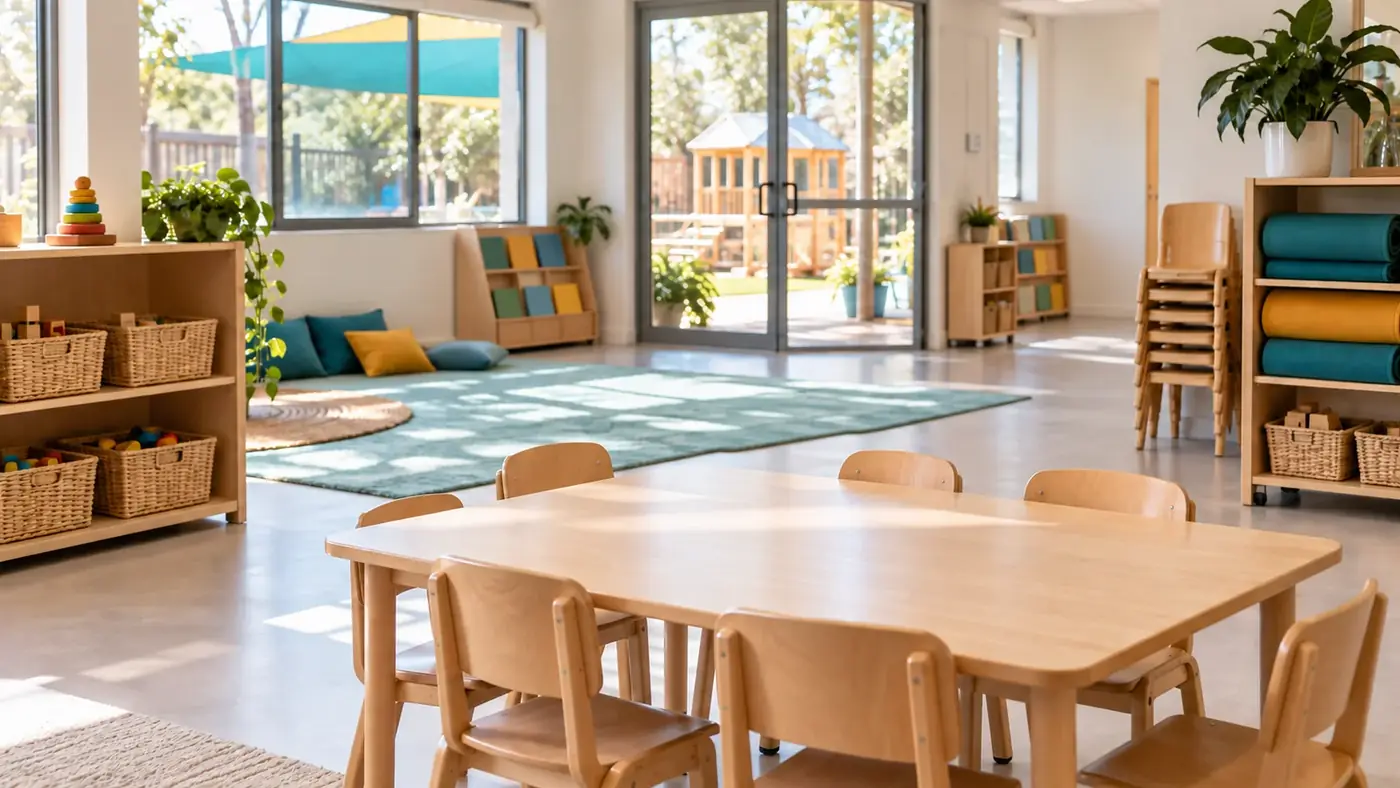
- Tables and chairs wiped
- Toilets and change mat done
- Mouthed toys swapped out
- Floors spot-mopped
- WWCC checkedVictorian card held by all staff
- Police checkedBefore any key is handed over
- $20M insuredPublic liability, on request
- Signed logsOne sheet per visit
What does daycare cleaning in Melbourne include?
Daycare cleaning covers every surface children use in a day: floors and carpets, bathrooms and the change area, meal tables, toys, door handles and switches, sleep mats and the kitchenette. High-risk surfaces are cleaned then disinfected at each visit, and the rest get detergent and water.
For most daycare facility cleaning jobs we come once the last child has gone home, but where a room runs two sessions a day we can also turn it around at lunchtime. The eight areas below make up the standard scope; anything unusual about your room is added after we have seen it.
- Floors and carpets
Hard floors mopped with neutral detergent, carpets and rugs vacuumed with a filtered machine.
- Bathroom and change area
Toilets, potties, basins, taps and the change mat, cleaned then disinfected.
- Meal tables and chairs
Tops, edges and the underside lip where food collects, plus chair seats and backs.
- Toys and resources
Mouthed toys and every toy used that day washed and air-dried, stored toys on a weekly rotation.
- Touch points
Door handles, gate latches, light switches, taps and the sign-in tablet or pen.
- Sleep mats and cots
Covers wiped and dried, frames done, and the floor underneath cleaned.
- Kitchenette
Benches, sink, fridge handle and microwave, with food-safe products only.
- Entry and bins
Entry glass at child height, pram area, bins emptied and relined.
Floors deserve a special mention because children spend so much of the day on them. Babies crawl, toddlers sit for group time and everyone eats close to the ground, so a daycare floor is closer to a table than a hallway. Hard floors are mopped with a neutral detergent that leaves no sticky film, rugs are vacuumed in both directions, and the edges along skirting boards get the same attention as the middle of the room.
Commercial daycare centre cleaning also has to respect how a room is set up for learning. Educators arrange resources on purpose, so shelves are cleaned and reset exactly as they were found, artwork on display is left alone, and anything an educator has laid out for the next morning stays where it is.
How does cleaning between sessions work?
A turnover clean happens in the gap between the morning group leaving and the afternoon group arriving. It is short and targeted: eating surfaces, the bathroom, mouthed toys and any spills on the floor, so the second group starts in a room as fresh as the first did.
Occasional care and sessional daycare services are where this matters most. When two different groups of children share one room on the same day, whatever the morning group leaves on a table or a toy is handed straight to the afternoon group. The Staying Healthy guidance treats a thorough detergent-and-water wash as the main defence for surfaces, and a turnover simply applies it at the moment it does the most good.
A turnover does not replace the full evening clean. It keeps the high-risk surfaces reset during the day, and the evening visit still does floors, sleep mats, the kitchenette and the weekly rotation. Some services book both; others ask their educators to handle the midday reset and use us at night only.
- Two groups use one room on the same day
- Meals are eaten in the play space
- Your educators are stretched at lunchtime
- A gastro or flu case has been reported this week
- A casual group joins the room on certain days
Educators can cover the essentials in ten minutes: wipe eating tables with detergent, check the toilet and change mat, and move mouthed toys into the tub for the evening team. We leave a laminated card with those three steps in every room we clean.
How are toys and high-touch surfaces sanitised?
Mouthed toys are washed in warm water and detergent, rinsed and left to air-dry, never just sprayed and wiped. High-touch surfaces such as handles, switches and taps are cleaned at every visit, and disinfected as well whenever illness is going around the room.
| Item | How we clean it | How often |
|---|---|---|
| Mouthed toys | Wash in detergent and warm water, rinse, air-dry on a rack | Every visit |
| Toys played with that day | Wash, rinse and air-dry, or a hot dishwasher cycle | Every visit |
| Stored toys not in use | Detergent wipe, rinse, dry | Weekly rotation |
| Soft toys and dress-ups | Bagged for a hot machine wash on your laundry roster | As scheduled, or after illness |
| Door handles, switches, taps | Detergent clean; disinfect during outbreaks | Every visit |
| High chairs and booster seats | Trays, straps and buckles washed, frames wiped, left to dry | Every visit |
| Sleep mat covers | Wiped with detergent, dried, stacked apart | Every visit |
| Sign-in tablet and pens | Wiped with a product safe for screens | Every visit |
Toys are where daycare cleaning is most often done badly. A spray-and-wipe leaves residue on something a toddler will chew the next morning, and it rarely removes the film of saliva that germs sit in. Washing, rinsing and drying takes longer, which is why we plan it into the visit rather than squeezing it in at the end.
High-touch surfaces are the other half of the job. Daycare staff and parents touch the same gate latch, door handle and sign-in screen dozens of times a day, so those points are on the log by name. The NHMRC Staying Healthy guidelines suggest cleaning these surfaces daily and more often during outbreaks, and our scope follows that.
Staying Healthy expects toys to be washed when the day ends, and it singles out the rooms with the youngest children. Plenty of daycare rooms make that easier by owning a double set of popular toys: while Monday's set dries on the racks, Tuesday's set is on the shelves.
Where a service has a commercial dishwasher, hard plastic toys can go through a hot cycle instead, and we will load and unload it as part of the visit. Wooden toys never go in, because heat and water split the timber and trap moisture where germs can grow.
For toy materials, drying racks and what to do with toys that cannot be washed, see our page on toy sanitisation.
How does family day care cleaning work in an educator's home?
Family day care cleaning covers only the parts of the home approved for care, cleaned to the same standard as a centre and booked around the household. The educator decides the scope, and the log is written so it can go straight into their records for the approved provider.
Every family day care home is checked by its approved provider. Under Regulation 116 of the national regulations, the provider must assess each residence before care starts and at least once a year, and that assessment looks at the nappy changing arrangements among other things. A clean change area and a record showing how it is kept help that visit go smoothly.
Visits are usually one evening a week or a Saturday morning, when the children have gone and the household can carry on around us. Family day care cleaning is priced per visit like any other service.
Homes bring things a centre never has. If there is a dog or cat, we clean the care area after pet hair and paw prints, and we check that outdoor play surfaces are free of droppings before the week starts. Pool fences and gates are the educator's responsibility, but if we notice one left open we say so on the log that night.
Educators working alone also tend to run out of time for the bigger jobs, so a quarterly visit to wash walls at child height and clean behind furniture is a common add-on.

- The play and rest area
- The bathroom children use
- The nappy change station
- Eating table and high chairs
- Toys and outdoor play surfaces
- Bedrooms not used for care
- The family's own kitchen cupboards
- Personal belongings and paperwork
- Anything you have not listed
Book an extra clean the week before. We focus on the change station, the children's bathroom, outdoor surfaces and the toy shelves, and the log from that visit gives you a written record to show the assessor.
Why do we send the same team every visit?
Because a daycare room is full of details that take weeks to learn: which toys are mouthed, where the sleep mats live, which cupboard is locked and why. A familiar team remembers all of it, and your educators never have to explain the room twice.
- 01Trust with keys and codes
You hand over access to a room full of children's belongings. Knowing who is inside after hours matters, and it is always the same two or three names.
- 02Nothing is relearned
A regular team knows your room order, your products and your quirks, so the standard stays level from one week to the next instead of dipping with every new face.
- 03Problems get noticed
People who see a room every week spot the slow leak, the cracked tile or the toy that keeps going missing. A rotating roster rarely does.
When a regular cleaner is on leave, the cover is someone who has already worked your room alongside them, and the handover notes travel with the keys. Day care centre cleaners in Melbourne often rotate staff across dozens of sites; our daycare cleaning service is built the other way round, with small teams attached to a small number of rooms.
Every new cleaner starts by shadowing an experienced one in a working room before they are given a site of their own. They learn how a change mat is cleaned, why a babies room is mopped last, what can and cannot be moved, and how the log is filled in, and they are not rostered alone until the supervisor has signed them off.
If a visit ever misses something, tell us by the next morning and the team comes back to put it right before children arrive, at no extra cost. The miss and the fix both go on the log, so the record stays honest.
The same team also handles the bigger jobs. Carpets, walls and furniture are done properly during the term break deep clean, by the people who already know where everything goes back.
What goes into a daycare cleaning quote?
Four things set the price: the size of the room or rooms, how many sessions run each day, how many visits you need each week, and whether you want turnovers as well as evening cleans. Send those and a written, fixed price comes back within 24 hours.
Daycare cleaning services are often quoted by the hour, which makes it hard to know what you are actually buying. We quote per visit, against a written scope, so the price only changes if the scope does. Before you ask for quotes, it helps to know what you want covered. Our free daycare cleaning checklist lists daily, weekly and term tasks by room, and doubles as a way to compare two cleaners line by line. For the wider picture across Melbourne, read about our childcare cleaning across Melbourne.
- 1Tell us about the roomSize, sessions, visits and any home-based sites.
- 2Quick look, if neededA short walk-through, often done the same week.
- 3Fixed price in writingPer visit, GST on its own line, no lock-in.
What do daycare operators ask us most?
These three come up with nearly every daycare and family day care enquiry we take. Anything else can be raised on the quote form, and the answer comes back in writing with your price.
01Can you clean between morning and afternoon sessions?
02Do you clean carpets?
03Same cleaners every time?
A cleaner room between groups, and a signed record every night.
Tell us your sessions and we will price the lot in writing.